
Guides
Food truck licences, permits and inspections: LA County and Texas examples
Food truck licensing requirements run on four clocks. Who issues what, with Los Angeles County and Texas permit fees, inspections and terms as examples.
What to take away
- A truck is licensed by several separate bodies at once. Approval from one of them is not evidence for any of the others, and each runs its own calendar.
- In most places the support kitchen question has to be settled before a health permit can even be applied for, which makes it the first call rather than a later detail.
- The people who can stop you trading are usually the health authority, the fire marshal, the municipal vending office and the vehicle registrar. Find out which of them exists where you operate before you buy anything.
- Keep one register of every documentissuing office, what it covers, when it lapses, and the person at your end who owns the renewal.
- The answers differ from one side of a county line to the other. Los Angeles County and Texas, worked through below, show how differently two places set the health permit, its fee and its term.
Why this cannot be a list of rules
Someone starting out wants a list: get these six things, in this order, and you can trade. That list does not exist, and any page that offers one is describing a single city and hoping you live in it. Mobile food is regulated at the level where the truck physically stands.
A state or territory sets a food code, a county or city health department administers it, a fire authority inspects the cooking equipment, and a separate municipal office decides whether commerce is allowed at a particular curb. Four bodies, four sets of paperwork, four renewal dates, and no obligation on any of them to coordinate.
So this guide gives you the shape of the problem, two worked examples, and the questions that get real answers where you trade.
Two worked examples: Los Angeles County and Texas
In Los Angeles County the health clock belongs to the county. Public Health permits and inspects all mobile food facilities in the county, enforcing the California Health and Safety Code everywhere except the cities of Long Beach, Pasadena and Vernon. A mobile food facility is a vehicle used in conjunction with a commissary or other permanent food facility, so the support kitchen comes first here too. Every truck must notify Public Health of its route and schedule, and update it when the route changes significantly, under Los Angeles County Code, Title 8, section 8.04.403. An approved truck carries a letter grade and a certification sticker showing it is a permitted food facility.
The county's mobile food facility fee schedule, in effect since March 6, 2024, sets annual health permit fees by risk: $325 for a low risk truck such as a prepackaged ice cream or produce truck, $598 for a moderate risk truck such as a smoothie, pizza or donut truck, and $761 for a high risk truck such as a taco, kebab or BBQ truck. Plan submittal for a new mobile food facility costs $544 at low or moderate risk and $741 at high risk, and a mobile support unit plan costs $441.
Texas runs the health clock from the state. Beginning July 1, 2026, every mobile food vendor must hold a licence from the Texas Department of State Health Services (DSHS); before that date, vendors needed a licence from the local health department of each jurisdiction they operated in. DSHS assigns one of three licence types by what the truck prepares: Type I for vendors who sell no time and temperature for safety (TCS) foods, such as prepackaged ice cream vendors; Type II for limited handling, such as coffee trucks and hot dog vendors; and Type III for trucks that prepare, cook and hold food, such as burger, BBQ and taco trucks. A pre-licensing inspection must be performed before the licence is issued, and the licence expires one year from the date that inspection was successfully completed. Application and pre-licensing fees are both due when the application is submitted: $309 for Type I with no pre-licensing fee, $618 plus $400 for Type II, and $876 plus $500 for Type III.
Neither example covers the fire, vending and registration clocks below. Those still sit with separate offices, and in Los Angeles County the cities of Long Beach, Pasadena and Vernon sit outside the county health enforcement described above.
Finding the authorities that apply to you
Start by identifying the agency, not the rule. The FDA publishes a state-by-state directory of the agencies that administer retail food regulation. It is the fastest route from "I will be operating in this state" to the office whose code applies and who administers it locally.
That directory does not tell you what your permit costs or how long it takes. It tells you who to ask. Most new owners get that wrong by asking a supplier or another operator instead.
Underneath the local rule sits a model text. The FDA maintains the Food Code, the model document that states and localities adapt, covering food handling, temperature control, equipment and facility expectations for retail food operations.
It shows the vocabulary your inspector uses. When a health officer asks about a three-compartment sink, potable water capacity or a food protection manager, those terms come from that lineage.
Knowing them makes the conversation shorter. The model text binds nobody, and your jurisdiction may have adopted an older edition, a newer one, or its own variation.
The four clocks
| Body | What it is deciding | Typical trigger to ask |
|---|---|---|
| Health authority | Whether the food operation, the truck's equipment and its support kitchen meet the adopted food code | Before you commit to a vehicle build or a menu |
| Fire authority | Whether the cooking appliances, fuel storage and suppression system are acceptable, and when they are reinspected | Before installing or altering cooking equipment |
| Municipal vending or business office | Whether commerce is permitted at a given location, on which days and hours, and under what fee | Before signing anything about a pitch |
| Vehicle and tax registration | Whether the vehicle is legal on the road and the business is registered to collect and remit what it owes | Alongside the business formation work |
Each of these has an application window, a review period and an expiry. They do not line up. A health permit that arrives in March and a fire inspection due in September mean two separate reminders, not one annual compliance day. Owners who treat licensing as a single event get caught by whichever clock runs shortest.
The support kitchen decides where you can park
This is the constraint most people meet last and should meet first. Many health authorities will not issue a mobile food permit unless the truck is associated with a fixed, permitted facility: somewhere to prepare, store, wash, take on potable water and dispose of waste water and grease.
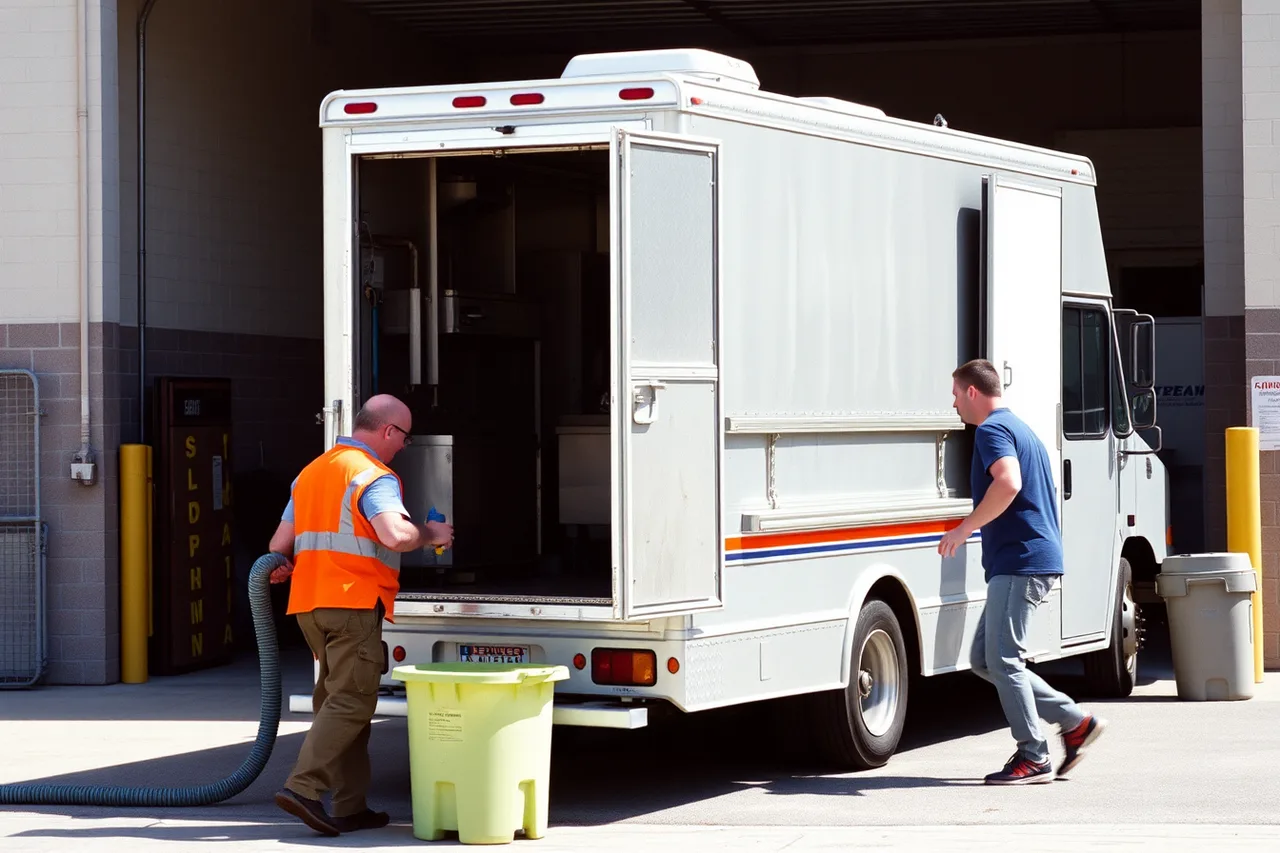
Where that requirement exists, it settles many other questions and fixes your daily start and end point. It sets a floor under your operating radius, because the round trip to that facility is time you cannot sell.
It can make a pitch on the far side of a metro area unworkable, even where the pitch is perfectly legal.
Ask the health department three things in order. First, does a support facility association apply here? If so, what documentation does it want, and must it come from a facility in its jurisdiction?
Third, what happens to the association when you operate in a neighboring county for an event? That question catches more operators than the first two, because a second jurisdiction often wants its own arrangement.
Where accessibility and employment rules sit
Two areas get left out of licensing conversations because no single permit covers them.
The first is accessibility. A service window, queue area, and ordering method are how the public reaches your business. Public accommodation obligations do not disappear because the business has wheels.
The Justice Department's guide to accessibility obligations for small businesses sets out the reasoning. Existing arrangements are assessed against what is readily achievable. The test applies to how customers reach the service, not the building type.
For a truck that means window height and the approach surface you park on. It also means whether the menu can be read or heard by someone who cannot see the board, and whether there is a way to order without standing in one spot.
The second is employment. The moment you have anyone on payroll, a separate body of rules attaches to hours, records and pay, and it is administered nationally rather than by your health department.
The Labor Department maintains compliance material aimed at new and small employers. It shows which obligations attach at what size and what records you must be able to produce. Tip handling, break rules and minor employment all vary by state on top of that, so treat the federal material as the floor and your state labor agency as the authority.
A register that survives an inspection
Build one document, kept with the truck and mirrored off it. For each item record the issuing office, a contact route, what it permits, and its lapse date.
Compliance Register Columns
- Issuing office
- Contact route
- What it permits
- Lapse date
- Renewal lead time
- Responsible person
- Activity stopped if lapsed
- Replacement lead time if refused
Note the renewal lead time the office asks for and the named person responsible. Add two columns most registers omit: what trading activity stops if it lapses, and the replacement lead time if refused rather than renewed.
That second column is the one that changes behavior. A permit that takes six weeks to reissue is not a six-week problem, it is a six-week closure. Owners who write that down renew early. Owners who do not, discover it in the week they needed the truck for a booked event.
Two habits keep the register honest. Review it on a fixed date every month rather than when something goes wrong, and photograph or scan every document the day it arrives, because the original will live in a folder in a moving vehicle. When the register and reality disagree, believe the office, not the folder.
When a rule changes under you
Codes change. Cities rewrite vending ordinances. A fire authority can change what it wants at the next inspection. None of it arrives as a letter addressed to you.
The practical defense is a short annual call to each of the four bodies, asking one question: has anything changed since my last renewal that affects a mobile operation. That call takes twenty minutes and is the cheapest compliance work available.
The other half is sequencing. Licensing constrains almost every other decision you will make, from how the menu is built around what the line can actually produce to the order the startup work has to run in. Nothing is bought before the thing that authorizes it exists.
Common questions
Can I use another operator's answers about permits?
Use another operator's experience only as a prompt for your own questions. They can tell you which office they dealt with and roughly how long it took, which is useful.
They cannot tell you what applies to your menu, equipment, vehicle or pitch. Any one of those can move you into a different category. Treat their experience as a map of the building, not the ruling.
Which permit should I apply for first?
Ask the health authority first, even if its permit is not the first one issued. Its answer about support facilities and about your menu often determines what you build, and what you build determines what the fire authority inspects. Applying in the wrong order usually means paying twice for the same modification.
Does an event organizer's permit cover my truck?
Assume not until someone in writing says otherwise. Event permits and vendor permits are frequently separate instruments, and the organizer is generally not the authority. Ask the organizer which body issued their permission, then ask that body directly what it requires from an individual vendor on that site.
What if the answers I get conflict?
Write both down with the date, office, and name of the person who gave each. Then return to the more senior of the two offices with the conflict stated plainly.
Conflicting guidance is common when a city ordinance and county health code overlap. It usually clears up fast once someone views both at once. Picking the answer you liked and hoping does not work.