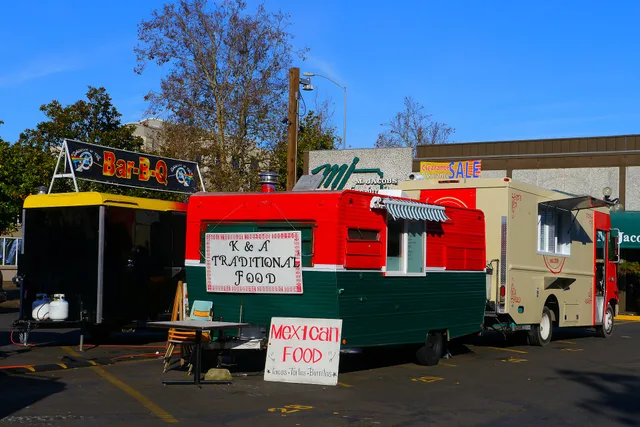

Guides
How to survey a food truck location in three tests
Food truck location survey in three tests: trading permitted, physical fit, and counted demand. Plus the support-kitchen round trip that decides the winner.
What to take away
- A pitch has to clear three tests in orderis trading here permitted, can the truck physically work here, and will enough people arrive. Most operators run them backwards and lose the deposit.
- Legality is decided street by street. The same block can be open on one side and closed on the other, because right of way and private property are governed by different offices.
- The physical test is where good pitches die quietlyno level ground, no legal place for waste water, exhaust blowing into the queue, or a generator louder than the local limit allows.
- Demand is an hour, not a place. A corner that is excellent at noon can be worthless at seven, and the same pitch supports two completely different menus at those times.
- Survey every candidate the same way, in writing, on a form. Comparing remembered impressions of four pitches is how a bad one gets chosen.
Why a list of good locations cannot exist
Ask ten operators where to park and you get ten answers about their own city, most of them out of date. Vending ordinances change, private lots change hands, and an event that filled a corner last summer may not run again.
A pitch is only good relative to a specific truck: its size, its power draw, its menu, its service speed and how far it sits from the support kitchen.
So this is a survey method rather than a list. Run it on every candidate, keep the forms, and the comparison makes itself.
Test one: is trading permitted here
Establish two things before anything else. Whose land is this, and which office governs commerce on it.
Public right of way is usually governed by a municipal vending or business office. That office decides if a permit exists for the spot and if it is exclusive. It also sets allowed hours and required distances from schools, hydrants, intersections, transit stops, or existing food business doors.
City names differ, but the permission itself is usually one of a few: a mobile food vending permit, a mobile food facility permit, a vending permit, or a peddler's license. Ask which of them covers a truck, whether it is tied to the truck or to a single spot, and what the office needs before it will issue one.
Private property is a different conversation. The owner's permission is necessary but often not sufficient. A land use or zoning question can still sit on top of it.
Ask both offices, not one. The most common expensive mistake here is a handshake with a property owner who genuinely believed their permission was the whole answer.
Two further questions belong in this test. What noise limit applies to a generator, and at what point is it measured. And what happens on event days, when a street may be closed, reassigned, or opened to vendors on entirely different terms.
The generator limit is normally set in the municipal noise ordinance rather than in the vending rules, and it is written as a sound level measured at a stated distance — a property line or a neighbor's window — not at the machine itself. Code enforcement or the health inspector can say which ordinance applies and how it is measured, because a generator that passes on an empty block can fail once buildings fill in around the pitch.
Test two: can the truck physically work here
Walk the site with a tape measure and a notebook. This is the part that cannot be done from a map.
| What to check | Why it decides the pitch | What to record |
|---|---|---|
| Level and surface | An unlevel truck affects cooking equipment, drainage and safety at the window | Slope, surface type, drainage direction |
| Approach and exit | A pitch you cannot leave at the end of a service is a pitch you will resent | Turning room, one-way streets, parking restrictions before and after |
| Service side | The window has to face where people can safely stand | Which side faces the sidewalk, and how wide that space is |
| Queue space | A line that spills into a roadway or blocks a doorway will attract complaints | Available depth, obstructions, accessible route |
| Generator position | Exhaust and noise both have to go somewhere acceptable | Distance to windows, doorways, seating, the queue |
| Waste and greywater | There is rarely a legal disposal point on site | Where waste goes, and how far the return trip is |
| Overhead and clearance | Trees, wires, awnings and canopies | Height at the parking position |
| Shade and weather | Heat load on the truck and shelter for the queue | Aspect, wind exposure, cover nearby |
The accessibility question sits inside this test rather than beside it. Public accommodation obligations are assessed against how customers actually reach a service, and the Justice Department's guide for small businesses explains that existing arrangements are measured against what is readily achievable.
On a truck the site is part of the answer. The surface someone stands on, the slope of the approach and whether there is room to wait without stepping into traffic are all choices you make when you choose the pitch.
Test three: will enough people arrive
Only now is footfall worth measuring, and it has to be measured rather than assumed.
Go and stand at the candidate at the exact hours you intend to trade, on the days you intend to trade, more than once. Count people passing. Count how many stop at whatever food is already there. Count how long anyone waits before leaving a queue. Write the numbers down with the date, the weather and the time band.
That last column matters more than people expect. A pitch that works in mild weather and empties in rain is a different business proposition from one under cover, and you will not learn which you have from a single visit.
Then write your expectation before you trade: how many orders in an hour, and the point at which you would call the pitch a failure. Without that line, any result gets explained as a success.
The constraint people meet last
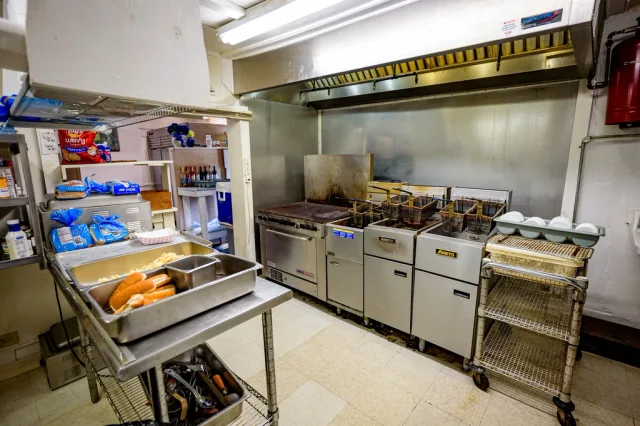
Distance from the support kitchen is a pitch criterion, not a logistics detail. Where your health authority requires an association with a permitted fixed facility, the round trip to it is unpaid time deducted from every trading day. A pitch forty minutes further out has to earn that time back before it beats a closer one.
Round trip: does it pay?
Does the pitch require a support kitchen round trip?
deduct unpaid hours from every trading day
pitch keeps its full trading window
Identify which body sets that requirement using the FDA's directory of the agencies that administer retail food regulation, then ask the local health department directly what applies and whether the arrangement travels across a county line. The answer draws a real boundary on the map, and every candidate outside it should be scored against the extra hours it costs.
The requirement usually comes from the FDA Food Code, the model code that most state and local retail food regulations are built on: a mobile unit is expected to work from a licensed commissary or support kitchen, and to return there for servicing, cleaning and waste disposal. The local health department sets how often that has to happen and how far the commissary may sit from the pitch.
Matching the pitch to the menu
A pitch does not just supply customers. It supplies a service pattern, and the pattern has to match what your line can produce.
A lunch pitch in a business district delivers a hard peak: most of the day's orders inside forty minutes, with everyone on a fixed break. That rewards a short menu with almost no cook-to-order steps, because a queue that stalls at the peak is money walking away.
An evening pitch outside a venue delivers a longer, softer curve and tolerates more complexity. A weekend market rewards visible product and impulse buying. The same truck can serve all three, but not with the same board, which is why the pitch decision and the decision about what the line can actually produce have to be made together.
The Bureau of Labor Statistics description of what running a food service operation involves is a useful reality check here: staffing, supplies, preparation, sanitation and customer problems, on schedules that regularly run nights and weekends. A pitch that requires a pattern the founding team cannot sustain for months is not a good pitch, however well it counts.
Scoring candidates against each other
Score every candidate on the same sheet, in the same order, with the same columns. Legality comes first as a pass or fail: a beautiful pitch you may not trade at scores zero.
Then physical constraints, each as a note rather than a rating, because one hard blocker outweighs several small advantages. Then counted demand with its dates, then round trip cost in hours.
Keep the losing sheets. When a rejected pitch changes hands or the ordinance is rewritten, the survey is done. You only update one line.
The Small Business Administration's guide to planning and running a business gives a reasonable orientation to permits and insurance that attach once you commit. Sequencing that commitment belongs with the dependency order the whole startup runs on.
Whatever you choose, record the permit conditions attached to it in a compliance register you keep with the truck: permit name and number, issuing office, expiry date, and the conditions that attach to the pitch. Pitch permissions expire on their own schedule and are easy to forget until an officer asks.
Common questions
Is a fixed daily pitch better than roving?
They are different businesses, and a fixed pitch builds recognition and lets you plan production, but depends on one permission and one crowd. Roving spreads risk and costs you repeat trade from people knowing where you are.
Most operations choose a small set of regular pitches, not either extreme, because that keeps production predictable without betting everything on one corner.
How many candidate pitches should I survey before choosing?
Enough that you are choosing rather than accepting. Two is not a comparison. Survey until you have at least three that pass the legality test, because the physical test will usually eliminate one of them for a reason you could not see on a map.
Can I rely on what another operator tells me about a pitch?
Use it to find candidates, never to score them. Their truck is a different size, their menu has a different service speed, their support kitchen is somewhere else and their permit may be older than the current ordinance. Go and stand there yourself, with the form.
What single factor most often kills a pitch after it is chosen?
Waste and water, closely followed by generator noise. Both are invisible when you visit at midday with a coffee, and both are unavoidable once you are trading daily. Ask about them on the first visit rather than the fourth.