Guides
Food truck inventory: cold chain, par and receiving
Food truck inventory across three places: the cold chain from support kitchen to service, par set by service rather than days, receiving steps, daily records.
What to take away
- A food truck inventory problem is not storage volume, it is the cold chain across three locations: the support kitchen, the drive and the service.
- Par levels on a truck are set against the length of a service, not against days. You cannot restock mid-lunch, so what you left with is what you have.
- Every item you carry occupies space that a faster selling item could have had. Range costs more on a truck than it does anywhere else in food service.
- Sourcing decisions are constrained by the same trip that constrains everything else: the round trip to the support kitchen sets how often you can realistically buy.
- Keep the records the tax authority expects and keep them daily, because reconstructing a season of purchases from a shoebox is worse work than doing it as you go.
The three place problem
A restaurant has one kitchen. A truck has a support kitchen where product is received and prepped, a vehicle in which it travels, and a service position where it is held and sold. Temperature has to be maintained across all three, and the two handovers are where it is lost.
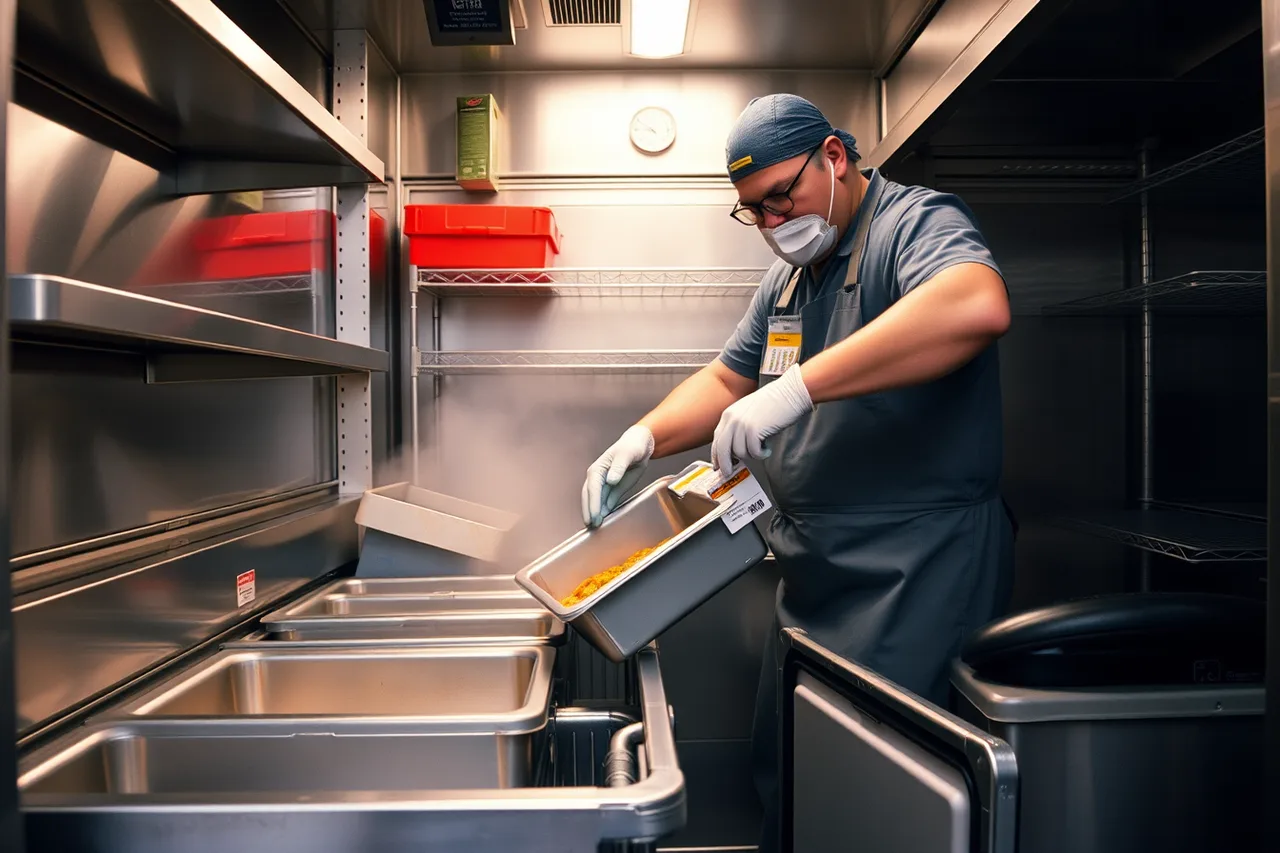
That is the frame for everything below. Most inventory failures on a truck are not shortages. They are product that was fine at seven in the morning and not fine at noon. A cooler was loaded warm, a lid sat open during a long drive, or the equipment was pulled down after loading rather than before.
The FDA Food Code is the model your state or local health authority adapts, and it is where this vocabulary comes from: cold holding, hot holding, cooling, reheating, and the separation of raw from ready to eat.
Read it to understand your inspector's categories. The figures behind those categories are cold holding at 41°F or below, hot holding at 135°F or above, cooling from 135°F to 70°F within two hours and to 41°F within six hours, and reheating to 165°F. Anything that has sat between 41°F and 135°F for more than four hours comes off the truck.
Those are the model numbers, and your state writes its own version of them, sometimes stricter. Get the figures and intervals your state adopted from your state or local retail food regulatory agency. If you are not sure which body that is, the FDA publishes a directory of the agencies that administer retail food regulation by state.
Par is a function of service, not of days
The single most useful shift in thinking is to stop planning inventory in days and start planning it in services.
A service is a defined block: this pitch, these hours, this expected volume. It starts when you load and ends when you return. Nothing arrives in between.
The par for each item is what the service needs, plus a margin for a better than expected day, capped by what the truck can hold at temperature.
Written as a formula, par for an item is the units you expect to sell at that pitch, plus a safety margin, minus whatever you are carrying over from the previous service. The expected units come from your own sell-out and run-out records, not from the case size the supplier wants to sell you. The margin is the amount that covers the services where you sold out, and nothing more.
That cap is real and it binds sooner than people expect. Cold space on a truck is small, and it is shared between raw components, prepped components and anything held ready. An item that needs a lot of cold volume per dollar of sales is expensive in a way that never shows up in its unit cost.
The range question
Every additional item on the board costs you three things: cold or dry space, a prep step at the support kitchen, and a decision at the window. The last one is the least obvious and often the most expensive, because a wider board slows the queue and throughput is the whole revenue model on a truck.
So the test for keeping an item is not whether it sells. It is whether it earns its space and its second of decision time better than the item that would replace it. Run that comparison item by item once a season, not by instinct.
| What an item costs you | How to see it |
|---|---|
| Cold or dry volume | Measure the space its par actually occupies, not the case size |
| Prep labor | Time the prep step at the support kitchen, once, honestly |
| Waste risk | Track how often its par comes back unsold |
| Queue time | Watch whether people pause at it on the board |
| Shared components | Note how many other items use the same component |
That last row rescues a menu. An item sharing components with three others carries almost no extra inventory risk, while an item with a component nothing else uses carries all of it, usually the item to cut.
Which items survive that test is the same question as what the line can actually produce at speed. The two decisions about what survives and what the line can produce belong in the same sitting.
Choosing suppliers around the trip
Sourcing on a truck is shaped by the drive. Where your state or local health authority requires association with a permitted support kitchen, usually under a mobile food unit or food establishment permit, that facility is where deliveries land and where you can hold anything, and the round trip to it is the constraint on how often you can restock.
Where you file depends on where you are. In California the vehicle permit is the Mobile Food Facility permit, issued by the county environmental health agency under the California Retail Food Code, and the support kitchen has to hold its own food establishment permit from the same agency. Most states use that same two-part structure under their own retail food rules: one permit for the truck, one for the facility that services it.
Three practical consequences follow. Delivery to the support kitchen is worth more than a marginally better price at a cash and carry, because a pickup trip competes with trading hours.
Order frequency matters more than order size, since holding more at the facility is usually cheaper than holding more on the truck.
A supplier with an unreliable delivery window costs more than one with higher prices, because a missed delivery on a service morning cannot be recovered.
Ask any prospective supplier the same set of questions and write the answers down. Minimum order, delivery days and window, what happens when something is short, how substitutions are handled, how they handle a temperature failure in transit, and what documentation comes with each delivery.
The answers matter more than the questions. Minimum order and delivery day: get the delivery onto the calendar as a service morning and treat the window as a hard commitment, because a window you cannot plan a service around is not a window. Shorts and substitutions: require approval before the order is picked, since an unapproved substitute that reaches a dish is the failure no invoice will flag. A temperature failure in transit: refuse the load, have the driver write the reading and the time on the delivery note, and photograph it before the truck moves, because that photograph is what turns a loss into a credit rather than an argument.
In practice, most trucks build a mix: a national broadline distributor such as Sysco, US Foods, or Performance Food Group for core proteins and dry goods; a cash-and-carry outlet such as Restaurant Depot, Costco Business Center, or Sam's Club for fill-ins; and local wholesalers, butcher shops, produce houses, or farmers markets for specialty items.
Receiving, and why it is a control point
Receiving is where most inventory problems could have been caught and were not. Do it in this order, every time.
- Check temperature at the point of delivery, before anything is moved to a shelf.
- Check quantities against the order while the driver is still there, since a shortage discovered afterward is a negotiation rather than a correction.
- Check dates and condition on every chilled and frozen line, and set aside anything damaged instead of shelving it.
- Accept or refuse any substitution explicitly, because an unapproved ingredient reaching a dish is a problem no invoice will flag.
- Photograph the delivery note and log any shortage the same day.
The acceptance test at the tailgate is short. Chilled product at 41°F or below, frozen product frozen solid with no sign of thaw and refreeze, and nothing accepted on the promise that it will be cooled down later. Write the reading, the time and who checked it on the delivery note before anything comes off the truck.
The order matters because each step is cheaper than the one after it. A temperature problem caught at the tailgate is a credit; the same problem caught at load-out is a lost service.
The reason to be strict here is that everything downstream assumes it. A par count is meaningless if the count included a case that was short. A cost figure is meaningless if a substitution went unnoticed.
Records the tax side expects
Purchases, waste and stock movement are business records, and the IRS is explicit in Publication 583, Starting a Business and Keeping Records, that a business chooses a recordkeeping system that clearly shows income and expenses and keeps the documents supporting purchases and other transactions. On a truck the temptation to let this slide is strong, because you are driving, cooking and selling in the same day.
The habit that works is small and daily. Photograph or scan every invoice and delivery note when it arrives, log waste at the moment it happens rather than at the end of the week, and reconcile stock on the same day as the service. A weekly catch-up session always becomes a monthly one, and a monthly one becomes a guess.
Most of that now lives in an ordering account, a supplier portal, or inventory software such as MarketMan, Craftable, Restaurant365, or the inventory modules in Square and Toast. That makes it a small security question and an accounting one.
NIST publishes Small Business Information Security: The Fundamentals, quick-start guidance aimed at small organizations covering the basics of protecting the accounts and records a small business depends on. The relevant part is mundane: separate logins per person rather than a shared one, and knowing what a supplier account can order or charge if someone else gets into it.
Where inventory meets the rest of the operation
Inventory sits downstream of the pitch and upstream of the menu. How far the pitch is from the support kitchen decides restock frequency, which is why the round trip is a scoring column in the pitch survey method.
What the health authority requires of your storage, transport and holding is part of the compliance register and its inspection cycle. And the whole thing is one of the dependencies in the startup sequence, because a support kitchen that cannot hold your par is a problem you want to find before signing.
Common questions
How much should I carry beyond the expected par?
Enough to survive a better than expected day, and no more than the truck can hold at temperature.
Set the right margin from your own records: how often you sold out, and by how much, over a run of comparable services.
A margin chosen by feel is either constant waste or constant lost sales. And both are invisible until you write them down.
Should I prep at the support kitchen or on the truck?
Wherever your health authority permits, and then wherever it costs less time at the window. Prep done at the facility is usually cheaper, because it happens off the clock of a service and in a bigger space. What stops it is shelf life and quality, so the answer is item by item rather than general.
How do I stop waste without running short?
Measure both. Log what came back unsold and log every time you ran out, for the same items, over the same services. Most operations track only one of the two and then optimize themselves into the other. The pair together tells you which items have a par problem and which have a demand problem.
Is buying in bulk worth it?
Only if you can hold it at the right temperature, in the right place, for its shelf life, and if the money tied up in it is not needed elsewhere. On a truck, bulk buying frequently converts working capital into cold storage you do not have. Price the space and the cash before the discount.