Guides
Food truck POS and card readers: what the fees do to a $12 lunch
Compare food truck POS systems and card reader fees on a $12 ticket: Square, Clover and Toast rate structures, interchange plus math and contract costs.
Food truck POS and card readers: what the fees do to a $12 lunch
What to take away
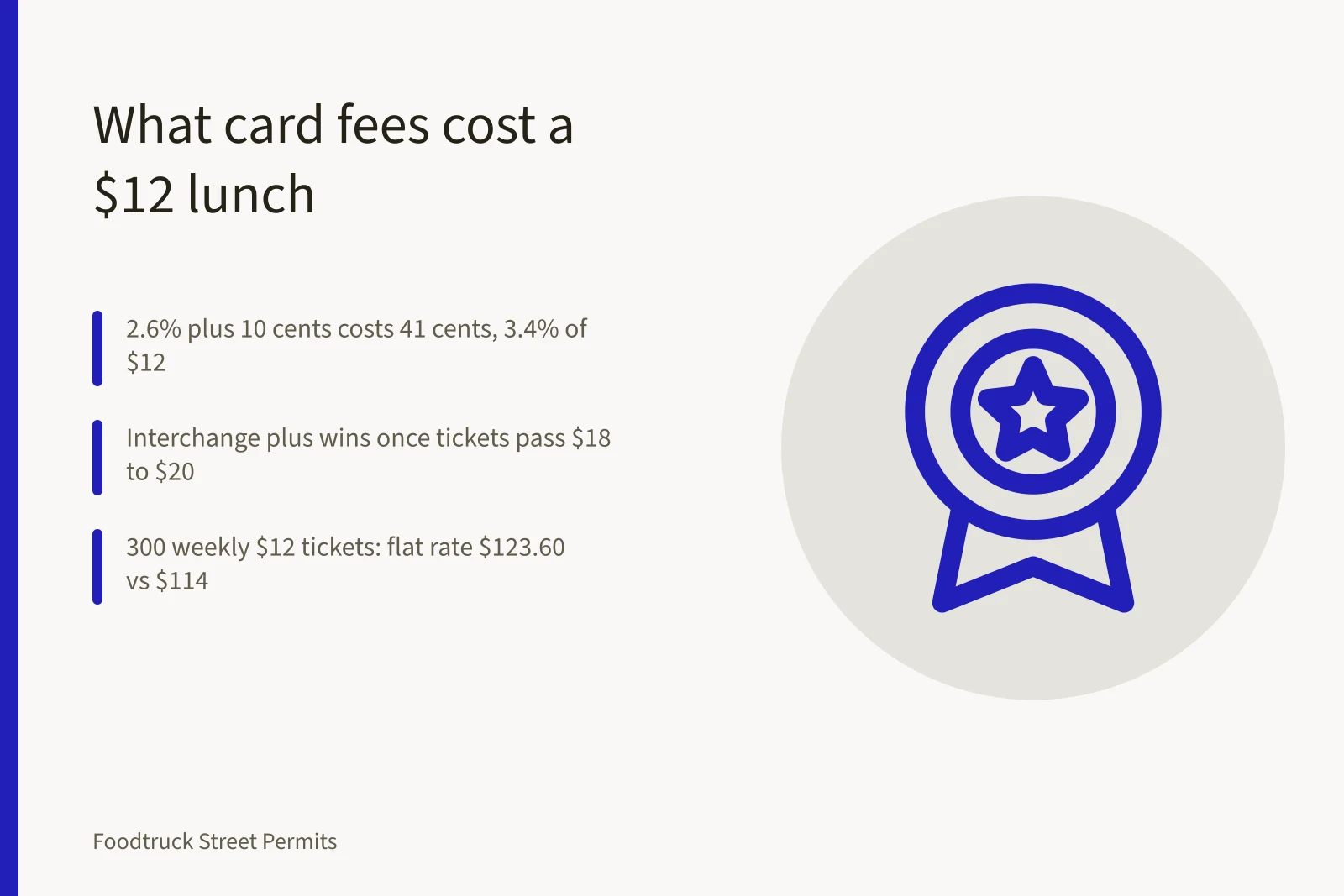
- On a $12 card sale, a flat rate of 2.6% plus 10 cents costs about 41 cents, or 3.4% of the ticket.
- Flat rates punish small tickets, because the fixed dime barely shrinks when the ticket does.
- Interchange plus pricing tends to win once average tickets pass roughly $18 to $20.
- Monthly, PCI and termination fees can cost more than the rate gap between two readers.
- The food truck software reviews and verdicts page has a twelve point weighted trial to run before you pay for a subscription.
The $12 lunch, line by line
Assume your processor charges 2.6% plus 10 cents on every tapped card. On a $12 lunch, the percentage takes 31 cents and the fixed piece takes another 10 cents. The sale costs 41 cents, or 3.4% of the ticket.
Add a 20% tip and the ticket reaches $14.40. The fee grows to about 47 cents, because percentage pricing scales and the dime does not.
A 10 cent swipe fee looks harmless next to a 2.6% rate. On a $6 pastry and coffee ticket, that dime alone is 1.7% of the sale.
Square, Clover, Toast and the pricing models
Pricing model
- Square
- Flat per tap rate, no monthly fee on the free plan
- Clover
- Rates and terms set by the reseller or bank
- Toast
- Flat card present rate aimed at restaurants
- SumUp and Zettle
- Flat rate on inexpensive readers
- Stripe Terminal
- Flat card present rate on a developer account
Contract shape
- Square
- Month to month
- Clover
- Often multi year with an early termination fee
- Toast
- Terms set deal by deal
- SumUp and Zettle
- Month to month
- Stripe Terminal
- Month to month
Where the cost hides
- Square
- Hardware, instant transfer fees, higher manually keyed rate
- Clover
- Monthly service fee, PCI fee, leased hardware
- Toast
- Hardware leases, add on modules, termination fee
- SumUp and Zettle
- Slower payouts, limits on large tickets
- Stripe Terminal
- Reader cost, setup work, thin counter service support
The sticker rate is often the smallest variable. A low rate bundled with a monthly fee can cost more than a slightly higher rate with no monthly fee once volume drops.
Toast and Clover reach most trucks through sales reps, so two identical trucks can sign different rates in the same month.
When interchange plus beats a flat rate
Interchange plus pricing passes the card brand cost through and adds a markup. On a $12 ticket the gap against a flat rate is small, since interchange on a plain consumer credit card sits in a similar range. The gap widens on large tickets.
A $60 catering order at 2.6% plus 10 cents costs $1.66. At an assumed interchange of 1.5% plus 10 cents, with a 0.1% and 10 cent markup, the same order costs about $1.16. That is 50 cents per order.
Debit interchange is capped by federal rules at roughly 21 cents plus a small percentage, so debit taps cost less than premium rewards cards. Your effective rate never matches the posted number exactly.
Example: a week of $12 lunches
A week of $12 lunches
- Count card tickets for one week. At 300 tickets and a $12 average, card volume is $3,600.
- Apply the flat rate. The percentage takes $93.60, and 300 taps at 10 cents add $30. The week costs $123.60.
- Apply interchange plus. At 1.5% plus 20 cents blended, the week costs $54 plus $60, or $114.
- Compare the gap. About $10 a week, or roughly $500 a year, before any monthly or PCI fee.
A $25 monthly fee plus a monthly PCI charge closes that gap before the year ends. Fees that ignore volume decide close comparisons.
Rules that change the math
Major card network rules in the United States permit a surcharge of up to 3% on credit card transactions, with disclosure at the point of sale. Debit cards cannot be surcharged. State rules differ, and a few states ban the practice outright, so regulatory compliance is a local question rather than a national one.
Refunds are another leak. Many flat rate processors keep the original fee when you refund a ticket, and a disputed charge can carry its own fee. Ask for both numbers in writing.
San Francisco publishes a food truck permit fees schedule that belongs in the same break even sheet as your card rate. A business license is separate from your merchant account, and neither one travels automatically when you sell the truck.
What to ask before you sign
- The card present rate, the manually keyed rate and the rate for a tap on a phone.
- Every monthly charge in dollars, including PCI, statement and batch fees.
- The contract length, the early termination fee and the notice period.
- Whether a refund returns the processing fee, and what a chargeback costs.
- Whether the reader holds offline sales when the signal drops at a festival.
Run your own ticket mix through each quote. A truck selling 60 tickets a day at $12 gets a different answer than one selling 15 tickets at $40.