Guides
How to test food truck packaging with a walk test and five bench tests
A walk test and five bench tests for food truck packaging, plus the steam problem, peak speed, health authority questions, printing claims, and packing training.
What to take away
- Packaging on a truck is tested by the walk, not by the counter. Almost every customer leaves holding the food, standing up, often with one hand occupied.
- Run a bench test before committing to any container. Five tests, ten minutes, and they will eliminate most candidates.
- Steam is the enemy of anything crisp, and a lid that seals perfectly is often the reason food arrives soft.
- Packaging is also a throughput decisiona container that takes three seconds longer to close costs you those seconds on every order at the peak.
- Confirm with your health authority what the food contact and holding requirements are before you standardize on anything.
The walk test
Design for the customer who orders, takes the food, and starts eating within a minute while moving. That is the normal case at a truck, not the exception.
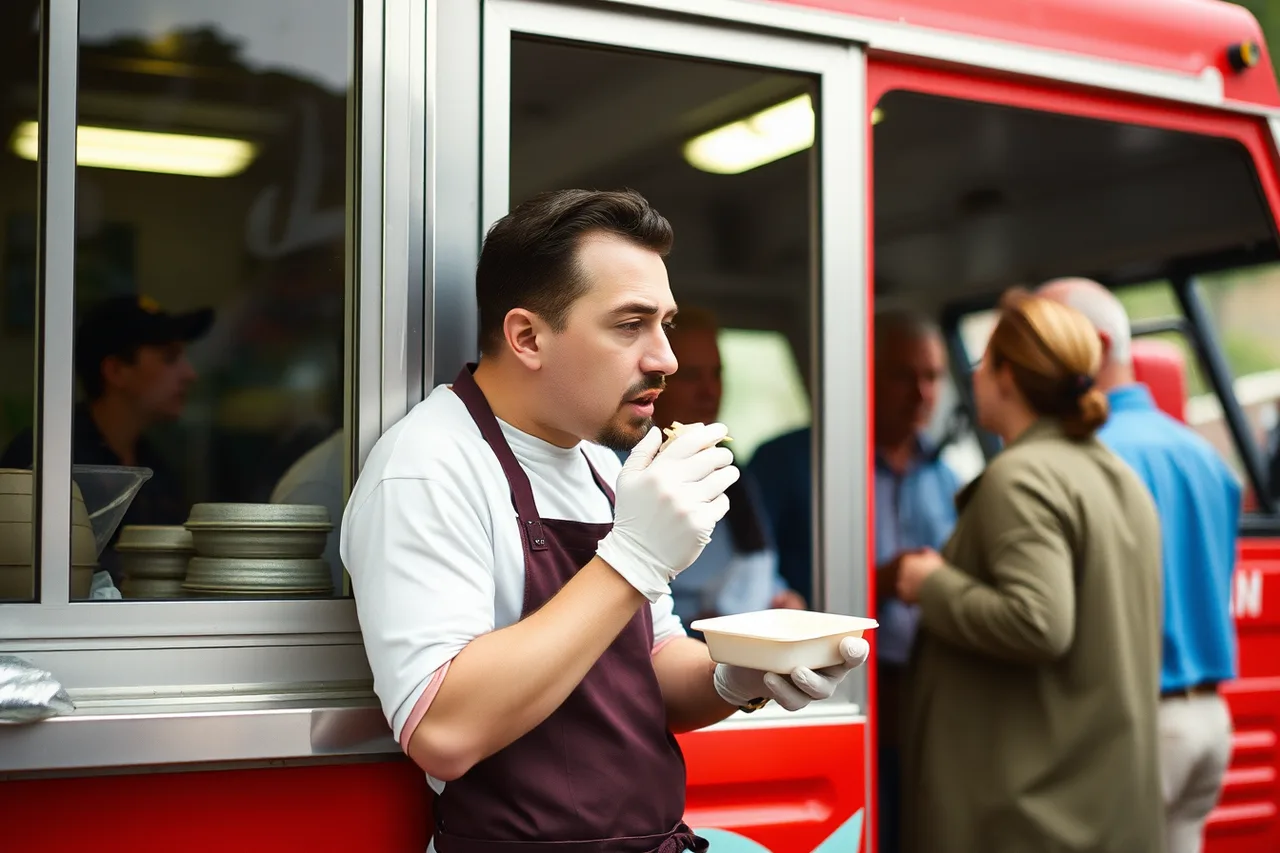
The container has to survive being carried in one hand, opened without a surface, and eaten from while standing. Anything that needs two hands, a table or cutlery you did not provide is a container a share of your queue cannot use. They will not tell you. They will order the other thing.
The five bench tests
Do these with a real portion of a real item, not with an empty box.
- The one-hand test. Carry it fifty paces, open it, and eat from it, without putting it down. If it needs a surface, note which items it therefore rules out.
- The steam test. Fill it hot, close it, wait the length of your typical queue, and open it. Look at whatever was supposed to be crisp. Repeat with a vent, and compare.
- The tilt test. Hold it at thirty degrees for ten seconds, then upright. Sauce migration and leaks show up here rather than on a bench.
- The stack test. Stack a realistic multi-item order and carry it. Most containers fail this in the same way, by crushing whatever is underneath.
- The close test. Time how long it takes to close, one handed, while wearing a glove. Multiply by a peak's worth of orders and you have a real number.
Write the results down per container and per item. The point of the tests is comparison, and memory does not compare five containers reliably.
The steam problem, stated plainly
Anything fried, toasted or seared arrives at the customer in whatever condition the container allowed. A sealed container traps moisture, and trapped moisture ends crispness within the length of an ordinary queue.
The tradeoffs are real and there is no universally right answer. Venting keeps texture and loses heat. Absorbent liners help and add cost per order. Separating a wet component from a dry one preserves both and adds a container, a closing step and a second of window time.
Decide per item, deliberately, and record the decision. The failure mode is drifting into one container for everything because it was on the shelf.
Packaging as a speed decision
At the peak, packaging is part of the line. Every container is a set of movements: reach, open, fill, close, hand over. A container that adds two seconds costs the same two seconds on every order during the only window that matters, and a queue that stalls is money walking away.
What it buys
- Preassembled wraps or boxes
- Almost no window time
- One container for several items
- Fewer movements, simpler stock
- Separate wet and dry components
- Quality on both
- Vented container
- Texture preserved
- Custom printed packaging
- Recognition after the customer leaves
What it costs at the peak
- Preassembled wraps or boxes
- Range and flexibility
- One container for several items
- Compromised texture on at least one item
- Separate wet and dry components
- An extra close and an extra hand movement
- Vented container
- Heat loss, and sometimes a spill risk
- Custom printed packaging
- Lead times and minimum orders
Set the layout so the packaging for your fastest selling item is within reach of the person who closes it. That sounds trivial. It is worth more per service than most menu changes.
What the container has to be able to do legally
Food contact materials, holding and the way food is protected from contamination are matters for your health authority rather than for a supplier's catalog description. Ask what is expected of a mobile unit specifically, since storage of clean packaging on a truck can attract its own conditions.
The vocabulary your inspector will use comes from the model food code your authority adapts, and the answers that bind you come from the department itself. Record those answers in your own permit register rather than in a supplier email you will not find again.
What you print on it
Anything printed on a container is a claim you own. The Federal Trade Commission's advertising guidance for small businesses requires claims to be truthful and supported.
That applies to a sleeve or a sticker. Compostable, recyclable, local and house made are claims, and repeating a supplier's wording does not transfer responsibility for them.
The practical rule is to print what you can prove and leave the rest to the board, where it is easier to correct.
Costing packaging honestly
Packaging cost per order is not the container price. It is the container, plus the liner, plus the bag, plus the napkin and the utensil that go with it, plus the share that gets wasted through damage and over-issue. Total that per item and it changes several menu decisions.
Keep the invoices. The IRS is explicit that a business keeps a system that clearly shows income and expenses with documents supporting purchases, and packaging is one of the lines that drifts quietly upward while nobody is watching it.
Once you have the real per order figure, put it in the board ranking. An item with expensive packaging is weaker than it looked.
That calculation is in how to rank a board with your own numbers. How it interacts with the board design is in how a menu is built backwards from the line.
Training the packing step
Packing is where consistency is lost. Two people can fill the same container differently enough that customers notice, and portion drift in packaging is invisible until the food cost moves.
Standardize the movement, not the portion alone: what goes in first, which way the item faces, where the napkin goes, how the bag is folded. Teach it as a sequence, not a preference. That belongs with the rest of what a new person on the truck is taught before a first peak.
It is re-taught when the operation adds a pitch or a unit, one of the questions in the growth decisions.
Common questions
Should I use compostable packaging?
It is a legitimate choice and also a claim. Buy it because you want it, not because it looks good on a sleeve.
Two practical checks first: whether it survives your steam test with hot food, and whether any place your customers actually stand has a collection that accepts it. A compostable container in a general waste bin is compost nowhere.
Is custom printed packaging worth it?
It buys recognition after the customer walks away, which is real, and it costs lead time, minimum orders and storage space at the support kitchen. Start with a sticker on a plain container. It gives you most of the effect and none of the commitment.
How do I stop bags and napkins disappearing?
Issue them deliberately rather than leaving them out, and count them like any other stock line. Self-service napkins on a truck are consumed at a rate that surprises people, and the cost hides inside a category nobody reviews.
What packaging should I hold as backup?
One neutral container that can take any item badly, in a small quantity. It is insurance for the service where a delivery is short, and it should be genuinely uncomfortable to use so that nobody reaches for it out of convenience.